Supply-chain collaboration · Toyota × o9

Triage
Room.

A shortage. Many people. One room.

When a part runs short, fixing it scatters across teams, spreadsheets, and calls. I designed the shared room where Toyota and its suppliers work through it together.

Workflow design

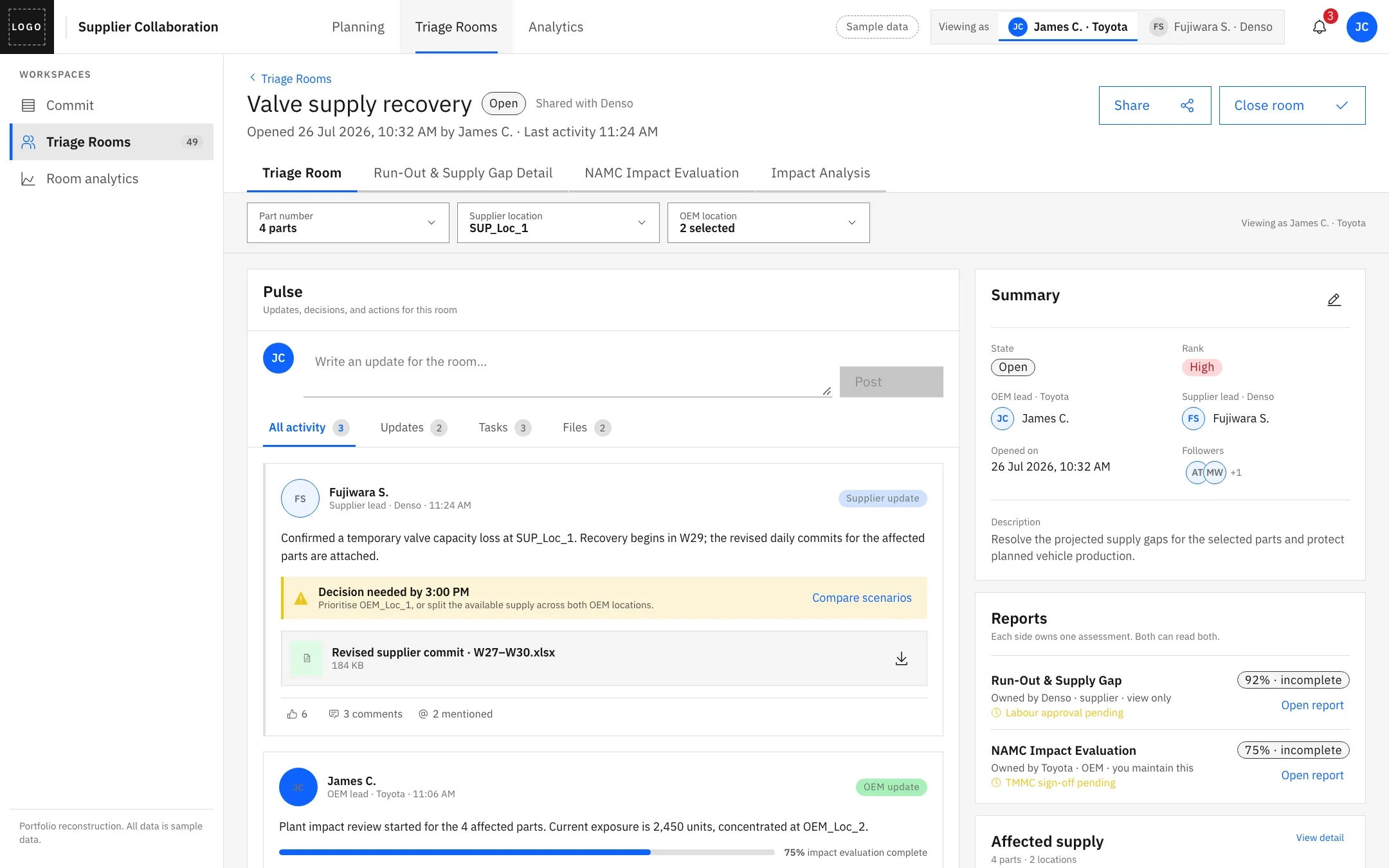
Supplier Collaboration / Triage Room
A Triage Room: the Pulse conversation in the centre, the room summary, report status, and affected supply on the right.

5 / 5Five questions, one place: 4 parts · SUP_Loc_1 · 2 OEM locations · both leads named · two owned reports · the pending decision and when it’s due.Prototype · sample data

Problem
A visible shortage.
A scattered response.
My role
Product DesignerJourney mapping, information architecture, wireframes, workflow, interaction & interface design, user validation
Worked with
Product, R&D, ToyotaBuyer-side and supplier-side workflows
Result
Launched with ToyotaLater extended and productized for the wider platform
Scroll to unpack

01 / Context

Before screens,
understand the room.

W / 01WHO

Two organisations.
Three questions.

SU

Supplier teamKnows the constraint and the recovery plan.When can we recover supply?

PL

OEM plannerKnows which plants and vehicles depend on the part.What does this mean for production?

DM

Decision makerNeeds the risk, the owner, and the next action.Where do we need to step in?

W / 02WHY
Context split across tools↓Every handoff re-explains the issue↓Ownership blurs↓Decisions wait↓Production at risk
W / 03WHAT

One response, five moves.

01Detect→02Bring people in→03Assess impact→04Agree on action→05Close the loop
W / 04WHEN

When a part runs short.

A supply gap in the planBuyer and supplier, two companiesCommercial confidentialityTime pressureMany parts × many plantsDecisions that need an owner

Not a chat tool.
An operational response.

INPUT / 01A requirements tableIt named the pieces, but not how a person moves between them.

INPUT / 02Toyota reviewsEach direction was walked through with Toyota stakeholders.

INPUT / 03Platform & engineering reviewsWhat the product could build, reuse, and support.

INPUT / 04A user validation sessionA check that the connected journey made sense to its users.

02 / The disconnect

The shortage was visible.
The way forward wasn’t.

A planner could see a supply gap. What they couldn’t see in the same place was who was fixing it, what had changed, or which decision was still waiting.

The planning system held the numbers. Email, calls, and spreadsheets held the rest. Each team had a piece of the story, and every handoff meant piecing the situation together again.

Planning system

The numbers.

The gap by part, supplier site, plant, and week.

How big is the gap?

Email & calls

The explanation.

What is constraining the supplier, and what recovery looks like.

Why is it happening?

Spreadsheets

The impact.

Which plants and vehicles are exposed, and how soon.

What will it cost production?

People’s memory

The decisions.

Who agreed to what, on which call, and who acts next.

Who is doing what next?

The information existed.
It just didn’t live in one place.

The record, before the room · 0 of 5 in one placeEvery shortage raised the same five questions. Each answer lived somewhere else.
QuestionWhere the answer lived
01What’s short, and where?Planning systemThe gap by part, supplier site, plant and week.
02Who is on it?People’s memoryWho acts next, and who agreed on which call.
03What do we know?Email & callsSpreadsheetsThe supplier’s explanation in one place, the plant impact in another.
04What’s been decided?People’s memoryWho agreed to what, on which call.
05What happens next?People’s memoryWho is doing what next.

The room had to answer all five without a search.Sources: the four fragments above

UX lensA shared mental model

The problem wasn’t a lack of information. Each team held a different piece of it. The design had to make those pieces understandable together, while respecting the different decisions each side is responsible for.

03 / The brief

How might we turn a visible shortage into a coordinated response?

How I framed it

I translated the requirements into one connected journey: detect a gap, bring the right people together, assess the impact, agree on action, and close the loop. To hold that journey, every room needed three parts, each answering its own questions.

The journey, by who actsDiagram · drawn from the requirements and original designs
  1. Detect
    OEM

    The planner selects the shortage rows in the planning workspace.

  2. Bring people in
    Before the room · off the record

    The planner reached the supplier by email and calls.

    Shared room

    The room opens with the scope and both leads.

  3. Assess impact
    Supplier owns

    Run-out & supply gap report

    OEM owns

    Plant impact report

    Both sides read both reports.

  4. Agree on action
    Shared room

    The decision goes on the record.

  5. Close the loop
    Shared room

    The room closes and stays a readable record.

How to read it

Each lane is who acts. The shortage enters from the OEM’s planning rows and stays in the shared lane until the room closes. Before the room, the same work ran between the two companies off the record.

The room as a plan. Report tabs across the top hold the assessment and answer question 03. The conversation fills the centre and answers questions 04 and 05. The summary on the right holds the scope, both leads, the state and report completeness, and answers questions 01 and 02. Room · Open ROOM RUN-OUT & GAP PLANT IMPACT ASSESSMENT · 03 Write an update for the room… CONVERSATION · 04 · 05 Summary 4 parts · 2 plants OEM lead Supplier lead CONTEXT · 01 · 02

The room, as a plan

Three zones, five answers. The summary holds where the shortage stands and who owns it. The conversation carries what’s happening. The reports, one tab away, hold what each side knows.

A plan of the prototype’s room layout, simplified. The numbers are the five questions.

Answers 01 · 02

Context

Where do we stand?

The exact supply problem and the people accountable for it, visible the whole time.

  • Part × supplier site × plant scope
  • Buyer lead · supplier lead owners
  • Open · closed state

Answers 04 · 05

Conversation

What’s happening?

One running record of updates, files, tasks, and decisions, tied to the issue it is resolving.

  • Updates from both sides Pulse
  • Files and tasks attached
  • Decisions on record

Answers 03

Assessment

What do we know?

Two structured reports, one owned by each side, so comparable facts don’t get lost in the thread.

  • Run-out & supply gap supplier
  • Plant impact evaluation buyer
  • Completeness visible

Constraints

A shared room, inside real limits.

01One supplier per roomSuppliers are commercially separate. A shared shortage doesn’t make them one audience.Shaped → Boundary 01 · separate rooms
02Two owners, two reportsSuppliers explain supply; buyers assess production impact.Shaped → Decision 02 · owned reports
03Platform patterns firstReuse the existing conversation, form, and grid patterns before building new widgets.Shaped → The turn · Pulse at the centre
04Many parts × many plantsOne issue can span several part and plant combinations.Shaped → Decision 01 · rows carried in
05Start where people already workThe shortage is found in the planning workspace, so the room has to start there too.Shaped → Decision 01 · start from the rows

The goal wasn’t another chat tool.It was one shared account of the shortage.

04 / The turning point

First, I designed for tasks.
Then, for the conversation.

My first room looked organised: task counts, status cards, and a task grid. But a shortage doesn’t arrive as a tidy to-do list. People first need to explain what happened and work out a response.

Platform reviews added a second pressure: bespoke widgets would be costly to build and maintain. I moved the centre of the room to Pulse, the product’s existing conversation pattern, and kept the structured work beside it. Select a change to see where it moved.

The screens on this page are my designs, redrawn as low-fi in React with a neutral logo and sample names. Click through all 15 screens

First directionShown to Toyota · redrawn low-fi
Revised directionShown to Toyota · redrawn low-fi
  1. Before

    Task counts and a task grid took the main workspace. Work was visible, but the explanation behind it had nowhere to grow.

    After

    The Pulse conversation became the workspace. Updates, files, and decisions build one shared account of the shortage.

  2. Before

    Posts, tasks, and attachments were separate views, switched from a toolbar.

    After

    Files, tags, and tasks travel inside each post, so evidence stays next to the discussion it supports.

  3. Before

    The two reports sat behind buttons in the header, one step removed from the room.

    After

    Reports became tabs of the room: one step away, never somewhere else.

  4. Kept

    The summary: status, the two leads, report completeness, and the affected parts.

    Kept, on purpose

    It stayed beside the conversation in both directions. It’s the stable reference while the thread moves.

Force / 01 · People

Tasks follow explanation.

A shortage starts as a question, not an assignment. People need room to explain before they can divide the work.

Force / 02 · Platform

Reuse before rebuild.

Pulse, forms, and grids already existed. Bespoke task widgets meant more to build, integrate, and support.

The decision

Conversation at the centre. Structure beside it.

The tradeoff was deliberate: less task-management prominence, more space to coordinate. It changed the information architecture, not just the layout.

What informed the change?

My original design files show the shift from task widgets to a Pulse feed, a persistent summary, and report tabs; the screens here are redrawn from them. The project records describe stakeholder reviews and platform feasibility discussions as the inputs.

Reuse was a design decision too. It let people bring what they already knew about the product into a new workflow, and it limited how freely every interaction could be customised. I accepted that where a familiar pattern supported the work, and used hierarchy to give the room its purpose.

05 / Three decisions

One shared room.
Three decisions that made it work.

Decision / 01

Where should a room begin?

A / BLANK FORM

A standalone create pageFlexible
Re-enter what you already know

B / OPEN CHAT

A general channelFast to start
No defined issue

C / FROM THE ROWS

From the selected shortageContext arrives with the room
Tied to one issue
CHOSEN
SETUP EFFORTSCOPE CLARITYFLEXI­BILITY Blank form●○○●●○●●● Open chat●●●●○○●●● From the rows●●●●●●●○○

More dots = better for the person opening the room. A design judgement, not a measurement.

Why

I placed room creation beside the supply gap. Selecting the affected rows sets the part, supplier location, and plant before anyone starts explaining the problem. People check what’s already there instead of remembering identifiers and typing them again.

The tradeoff: a room is tied to a concrete supply issue. It’s less flexible than a general chat, and much clearer about what the conversation concerns.

Recognition over recall

EarlyRedrawn low-fi
Opened from the planning grid, but the parts still had to be added by hand.
RevisedRedrawn low-fi
The selected rows arrive as chips. You remove what doesn’t belong instead of adding what does.
Selected shortage rowsPart × supplier site × plantNamed buyer and supplier leadsA focused room, ready for the conversation

Decision / 02

Who can change what?

A / ONE SHARED DOC

Everyone edits everythingOpen
Nobody owns the facts

B / SEPARATE ROOMS

A room for each sideClear ownership
Back to piecing it together

C / OWNED REPORTS

Shared visibility, owned reportsBoth sides see both
Each edits its own
CHOSEN
SHARED PICTUREACCOUNT­ABILITYCONFIDEN­TIALITY One shared doc●●●●○○●●○ Separate rooms●○○●●●●●● Owned reports●●●●●●●●●

Confidentiality depends on a second rule: a room is shared with one supplier organisation only.

Why

A supplier knows why a part is running out. A buyer understands what that means for production. Sharing a room shouldn’t blur those responsibilities, so each side owns one report and can read the other’s.

The boundary: collaboration is scoped to the room’s participants. A common workspace must never imply access across suppliers.

Clear ownership

Supplier ownsReport form · redrawn low-fi
Run-Out & Supply Gap. When will parts run out, and what is constraining recovery?
OEM ownsReport form · redrawn low-fi
NAMC Impact Evaluation. What does the shortage mean for each plant?

Decision / 03

How does a moving conversation stay grounded?

A / ALL IN THE FEED

Everything is a postComplete history
The current state gets buried

B / ALL IN TABS

Everything is a pageTidy
Discussion loses its context

C / FEED + SUMMARY

Feed beside a steady summaryThe story moves
The facts stay put
CHOSEN
Why

A conversation explains how a decision happened. It doesn’t make the current situation easy to find. I kept ownership, status, report completeness, and affected supply beside the discussion, so everyone has a stable reference as the thread grows. The detailed reports wait one step away, in tabs.

Recognition over recall

Progressive disclosure

  1. Pulse brings updates, files, tasks, and decisions into one sequence, tied to the issue it is resolving.

  2. Owners, state, report status, and affected supply stay visible. Someone returning can reorient without rereading the thread.

  3. The two reports and the impact analysis live in tabs: the shared picture first, depth when the question calls for it.

Before → decision → after

BeforeExplain the issue from scratchin every email and call
Decision

Start the room from the selected shortage rows.

AfterContext arrives with the roompart, site, plant, and leads
BeforeOne thread, blurred responsibilitywho owns which fact?
Decision

Share the room, separate the reports.

AfterEveryone sees, each side ownsand suppliers stay separate
BeforeUpdates scattered across toolsthe current state is anyone’s guess
Decision

Put the conversation beside a steady summary.

AfterThe story moves, the facts stay putdepth one tab away

06 / The experience

From a supply gap
to a shared plan.

Prototype rebuildSample data

01 / Detect

The issue already has a context.

A planner selects the affected part-location rows. The selection summary shows what the room will carry: one supplier, two plants, and the projected gap.

Continuity from finding a problem to acting on it

Open this step in the prototype

Try it yourself.

Create a room from the shortage, switch between the Toyota and Denso views to see who can edit what, then close the room and watch it become a record. The data is sample data.

07 / Beyond the happy path

A good room also knows
when to say “not yet.”

The harder questions appeared at the edges. A rule is only useful if people understand why it exists and what to do next.

Each boundary below blocks something for a reason, and each keeps the planner’s work instead of throwing it away. The recovery designs shown here are from the rebuilt prototype.

Boundary / 01 · Confidentiality

Different suppliers, separate rooms.

A selection that spans two supplier organisations can’t become one room. A shared shortage doesn’t make competitors one audience.

RecoveryKeep the selection and split it: “Keep Denso rows” or “Keep Aisin rows”.

Boundary / 02 · Continuity

An active issue, one shared response.

A part and plant already in an open room shouldn’t start a competing conversation. The history and the ownership would split again.

RecoveryPoint to the existing room, or leave that row out and carry on.

Boundary / 03 · Lifecycle

Closing shouldn’t close every risk.

Closing a room stops editing but keeps the record. Unfinished reports are called out first, and a related part stays monitored while another room is open.

RecoveryFinish or request the missing report, or close knowingly.

My closed-state specMy notes · redrawn low-fi
A cross-functional review asked what a closed room still allows. I answered it element by element, in nine notes for developers.
The closed roomPrototype rebuild · sample data
The state says “closed”, and so does every control: posting, reactions, and report edits are off, and the history stays readable.

Review states,
not only screens.

UX lensError prevention & visible status

The open room looked finished long before its closed counterpart was. Defining what each state allows made the lifecycle coherent: a label, the available actions, and the explanation for unavailable ones all agree.

One-image summary

Same shortage.
Better sequence.

Before

Spot the gap

↓

Email the supplier

↓

Re-explain the parts

↓

Assess impact in a spreadsheet

↓

Reconcile on a call

↓Decide · who owns it?
ONE ROOM→
After

Select the affected rows

↓

Open a room with context and leads

↓

Each side completes its report

↓

Discuss beside the summary

↓

Agree on the next step

↓Close with a readable record

What changed

Evidence,
without invented metrics.

01
CONTEXT

A room tied to the affected supply, not a blank conversation.

02
OWNERSHIP

Visible leads on both sides and separate report responsibilities.

03
CONVERSATION

The discussion beside the current situation, not apart from it.

04
LIFECYCLE

A closed room that stays a readable, trustworthy record.

What I can say

The original artifacts show a connected workflow and a substantive change of direction. The project records describe an initial Toyota launch, then enhancements and productization.

What I don’t claim

A measured drop in resolution time, feature adoption figures, or engineering savings. The prototype’s analytics are sample data, and they’re labelled that way.

08 / Looking back

The real design problem was
the space between teams.

01

Platform feasibility pushed me to reconsider the room’s centre.

A useful constraint can change the right thing.

02

The room’s value depended on how context, authority, and lifecycle fit together.

Design the relationships as carefully as the screens.

03

Next, I’d test whether a returning participant can name the next action and its owner.

Shared context should become shared understanding.

Less piecing it together.More moving it forward.